
Lug Nut Plating and Surface Finishes: A Buyer’s Guide
Chrome, zinc, black coatings and beyond: what each finish costs you in corrosion resistance, looks and lead time, and how to specify the right one for your market.
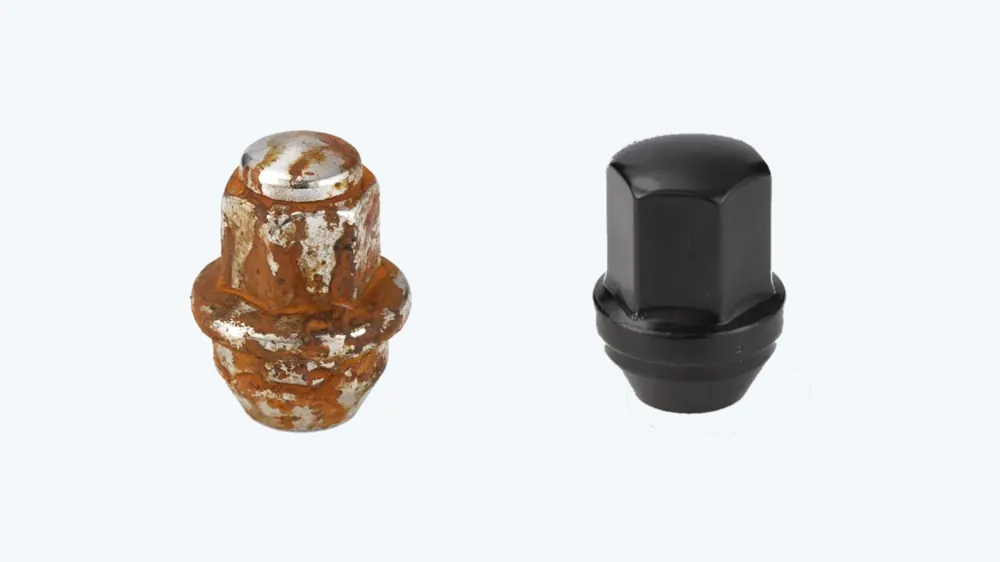
For the lowest cost, choose zinc. For a bright accessory look, choose chrome. For black wheels, choose black zinc, zinc-nickel or black e-coat. For salted winter roads, zinc-nickel is the safest choice: 500 to 3,000 hours in neutral salt spray, in a plated layer that resists chipping. Whatever you choose, look at adhesion as well as salt-spray hours, and agree the test in writing.
01Why the Finish Matters More Than You Think
A lug nut is small, but it sits on the most visible part of the car. When it rusts, the customer does not blame the nut maker; they blame the wheel shop or the brand on the box. For importers and distributors, the finish decides how many units come back as complaints after the first winter, and whether a range can be sold into markets with salted roads.
The finish also affects fit and safety. Coatings add thickness to threads and seats, and some electroplating processes can make high-strength steel brittle if they are not controlled. That is why the finish should be chosen together with the part, not added at the end.
02How Corrosion Resistance Is Measured
Most buyers compare finishes by salt-spray hours: parts are placed in a chamber with a fine salt mist and checked until the agreed failure appears, usually red rust on the base metal. Two tests matter for wheel fasteners:
- Neutral salt spray (NSS), the standard test for zinc and most functional coatings.
- Copper-accelerated acetic acid salt spray (CASS), a harsher test used for decorative chrome. An hour of CASS is far more severe than an hour of NSS, so the two numbers cannot be compared directly.
Only compare hours from the same test and the same failure criterion. As a reference, our zinc-plated parts are rated 96 h+ NSS, chrome 72 h+ NSS, and chrome can be supplied to 48 h CASS for OE programs. Every production lot is salt-spray tested before shipping.
03Salt-Spray Hours Are Only Half the Story
A salt-spray test is run on new, undamaged parts. On a car, a lug nut is handled, dropped into a box, hit by a socket and tightened with a wrench. So the second question is adhesion: how well the finish stays on when it is knocked.
- Plated finishes (zinc, black zinc, zinc-nickel, chrome) are deposited onto the metal and, when the plating process is well controlled, hold on well under normal handling and fitting.
- Paint and flake coatings (black e-coat, Dacromet / Geomet / Magni) can reach very high hours in the test, but a chip removes the protection at that spot, and rust starts there.
That is why a finish with fewer test hours but better adhesion can last longer on a real wheel. Choose by both numbers, and tell your supplier how the parts will be fitted.
04The Seven Finishes at a Glance
| Finish | Look | Corrosion resistance | Typical use |
|---|---|---|---|
| Zinc plated | Silver (clear) or blue | 96 h+ NSS | Cost-sensitive volume, OE replacement |
| Chrome | Mirror bright | 72 h+ NSS · up to 48 h CASS | Accessory and dealer ranges, OE programs |
| Black zinc | Satin OE-style black | 96 h NSS | Black steel and alloy wheels |
| Zinc-nickel | Black (shown) and other passivations | 500–3,000 h NSS | Salted roads, demanding OE requirements |
| Black e-coat | Even deep black | High in the test, but chips under impact | Decorative black ranges |
| Dacromet / Geomet / Magni | Matte silver-grey | Several hundred to 1,000 h+ NSS; can chip | High-strength bolts and studs |
| Anodized | Gold, red, blue and more | For aluminum parts | Tuner nuts, spacers, accessories |
05Each Finish in Practice
Zinc PlatedEconomical
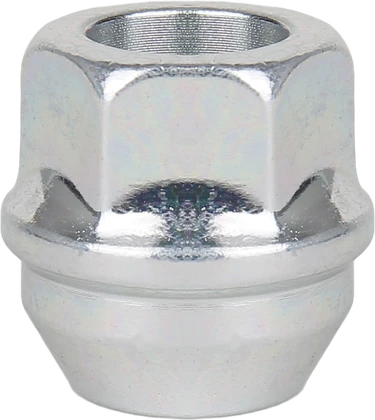
Electroplated zinc with a clear (white) or blue passivation. It is the everyday finish for volume ranges and OE replacement parts: lowest cost, easy to supply in any thread, rated 96 h+ in neutral salt spray.
ChromeBright
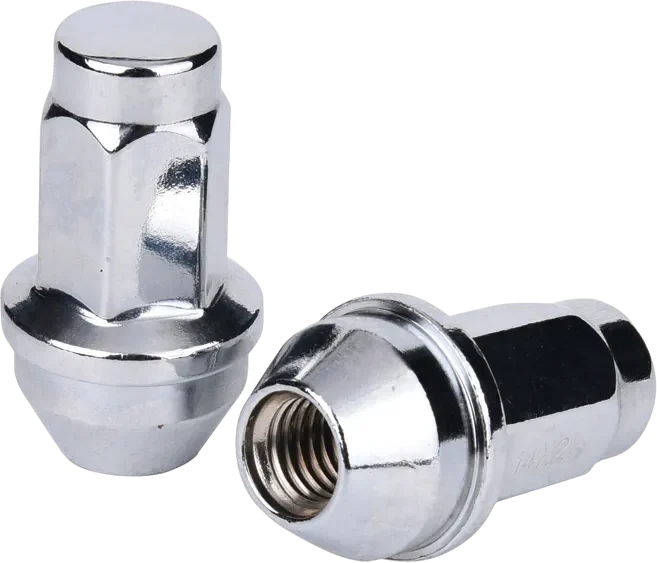
Decorative nickel-chrome plating with a mirror finish, the classic look for accessory and dealer ranges. Rated 72 h+ NSS, and available to 48 h CASS where an OE program asks for it. Many low-cost chrome nuts are two-piece: a simple through-hole steel nut with a thin chrome cap pressed on, which is cheap and easy to make. Water creeps under the cap, the steel rusts and swells, and the socket no longer fits. Our standard closed-end nuts are one-piece, formed blind and plated all over, with no seam to let water in; capped nuts are available when a customer asks for them.
Black ZincOE black
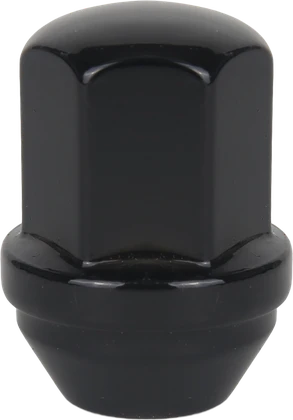
Zinc plating with a black passivation, giving the clean satin black seen on many factory wheels. Rated 96 h in neutral salt spray, a good match for black steel and alloy wheels at a moderate cost.
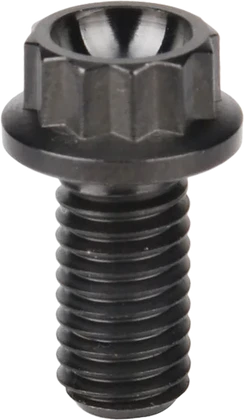
Zinc-NickelHigh corrosion
An alloy plating rated 500 to 3,000 hours in neutral salt spray, depending on the specification. Because it is plated, it holds on well under a socket, which makes it the strongest all-round choice for salted roads. Shown here with a black passivation.
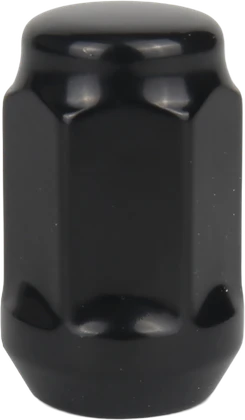
Black E-CoatUniform black
An electrophoretic paint that deposits an even black layer over the whole part. In the salt-spray chamber the paint resists corrosion very well, but it is mainly a decorative finish: a knock from a wrench or socket can chip it, and where it chips there is no protection left.
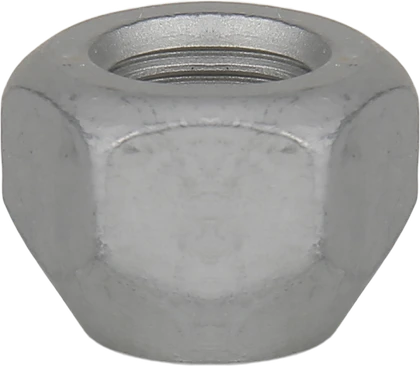
Dacromet / Geomet / MagniZinc flake
Zinc-flake coatings applied by dip-spin and cured, not electroplated, so there is no hydrogen embrittlement. Intact, they normally reach several hundred to over 1,000 hours in neutral salt spray, which makes them the usual choice for high-strength bolts and studs. Like paint, the coating can be knocked off, so parts need careful handling and fitting, and the layer is thicker than most plating, so threads must allow for it. Classic Dacromet can contain hexavalent chromium; Geomet and Magni are chromium(VI)-free, which matters for the EU, where it is restricted in vehicles.
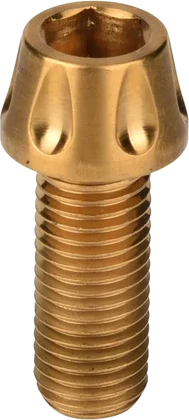
AnodizedAluminum only
Color anodizing for aluminum parts such as forged tuner nuts and wheel spacers, in gold, red, blue and more. It is not a finish for steel nuts; for steel, choose one of the coatings above.
06Choosing by Market and Wheel
Start from where the car is driven and what the wheel looks like, then pick the finish:
- Winter roads with salt (Northern Europe, Russia, Canada, northern US): zinc-nickel first; zinc-flake (Dacromet / Geomet / Magni) where parts are handled and fitted with care. Ask for the salt-spray hours you need.
- Warm, dry markets (Middle East, much of Latin America and Africa): zinc or chrome usually performs well and keeps cost down.
- Accessory and tuner ranges: chrome for steel nuts, anodized colors for forged aluminum nuts.
- Black wheels: black zinc for value, black zinc-nickel where corrosion matters most, black e-coat for decorative ranges where looks come first.
- High-strength bolts and studs (class 10.9): prefer zinc-flake coatings to avoid hydrogen embrittlement.
07What to Put in Your RFQ
A clear finish specification avoids most disputes later. With your drawing, OE number or sample, tell the supplier:
- The finish and color, for example “zinc, blue passivation” or “Geomet, silver”.
- For the EU and other regulated markets, that the finish must be free of hexavalent chromium (Cr6+).
- The salt-spray test (NSS or CASS), the hours, and what counts as failure.
- Any environmental or customer requirement your market applies to coatings.
- Whether the seat and thread must stay free of thick coating for fit.
- Packaging and labels, so finished parts are protected in transit.
Finishing usually affects lead time more than the part itself. Our standard lead time is 40–60 days after sample approval, depending on finish and quantity, and the minimum order is 5,000 pieces per specification.
08Questions Buyers Ask
Which lug nut finish lasts longest?
In everyday use, zinc-nickel: it is rated 500 to 3,000 hours in neutral salt spray and, being plated, resists chipping. Zinc-flake coatings such as Dacromet or Magni reach several hundred to over 1,000 hours when intact, but can be damaged by knocks.
Why do some chrome lug nuts swell and stop fitting the socket?
They are usually two-piece nuts: a through-hole steel nut covered by a thin chrome cap, a design chosen because it is cheap and easy to make. Moisture gets in at the seam, the steel underneath rusts and expands, and the hex grows. One-piece closed-end nuts plated all over do not have this seam, which is why they are our standard design.
Are stainless steel lug nuts or caps worth it?
Usually not for the price. Stainless nuts or caps can be made as a custom or OE project, but where a long corrosion life is the goal, zinc-nickel is the better choice: 500 to 3,000 hours in neutral salt spray, good adhesion, and lower cost than stainless.
Why did black e-coated nuts rust soon after fitting?
E-coat is a paint layer. It performs well in the salt-spray chamber, but a wrench or socket can chip it during fitting, and the steel underneath is then unprotected. For black nuts that must last, choose black zinc-nickel.
Is chrome a good choice for winter roads?
Chrome looks best and is rated 72 h+ in neutral salt spray, but where roads are heavily salted a zinc-flake or zinc-nickel finish will usually stay clean for longer.
Can you match the finish of my current supplier?
Yes. Send a sample or your coating specification and we match the finish and color through our partner plants, then test the samples before mass production.
Do you test every order?
Yes. Every production lot is salt-spray tested, and parts are also checked for thread fit, dimensions and appearance before shipping.