
Lug Nuts or Lug Bolts? How to Identify and Specify the Right Wheel Fastener for Any Car
The car decides nut or bolt; the wheel decides the seat and length. A brand-by-brand table, the four checks for every fastener, and what to put in your RFQ.
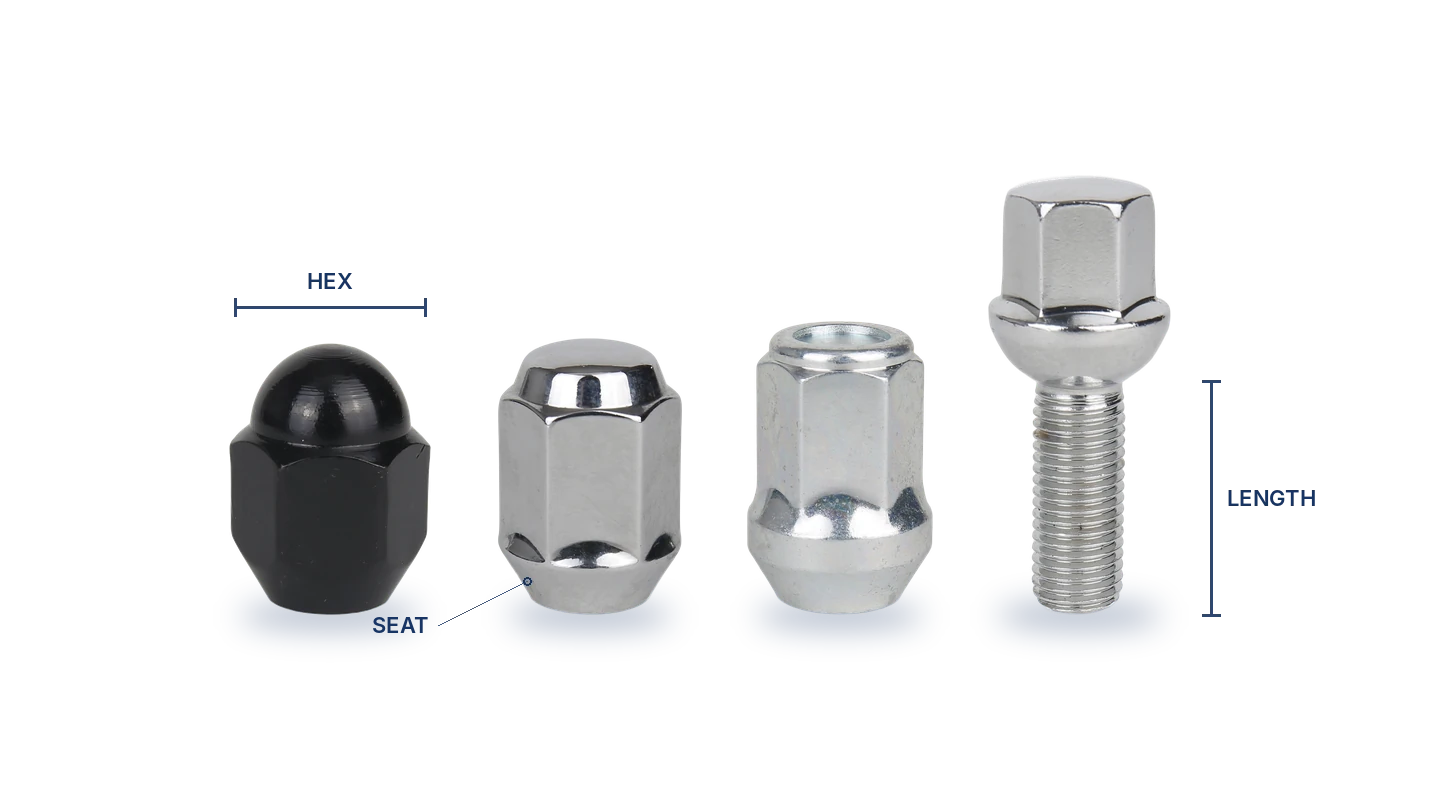
You do not choose between lug nuts and lug bolts: the car does. If the hub has studs sticking out, it takes lug nuts. If the hub has threaded holes, it takes lug bolts. Most European brands use bolts; most Asian and American brands use nuts. Once you know which one, every fastener is specified by the same four things: seat, thread, length and hex. Get all four right and the part fits; get one wrong and it does not, or worse, it fits and works loose.
| Brand group | Usually uses | Example from our range | Exceptions to watch |
|---|---|---|---|
| Volkswagen, Audi, Skoda, Seat, Porsche (modern) | Lug bolts, ball seat (R13 / R14) | VW Golf: M14×1.5, ball R13, 17 mm hex, 27 mm thread | Classic Porsche 911 and VW Transporter T2 / T3 use nuts |
| Mercedes-Benz cars | Lug bolts, ball seat (R12 / R14) | C-Class (W204): M14×1.5, ball R14, 17 mm hex | Sprinter and Vario vans use nuts, flat seat |
| BMW, Mini | Lug bolts, 60° cone | BMW F-series: M14×1.25, 60° cone, 17 mm hex | — |
| Peugeot, Citroën, Opel, Renault, Dacia, Fiat, Alfa Romeo, Lancia, Saab | Lug bolts, 60° cone or flat | Peugeot 208: M12×1.25, cone (steel wheels) or flat (alloy wheels) | Peugeot 4007 / 4008, Citroën C4 Aircross, Opel Astra J / Insignia B / Mokka, Renault Koleos, Fiat Fullback use nuts |
| Volvo | Mostly lug bolts, 60° cone | XC90: M14×1.5, 60° cone, 19 mm hex | C30, S40, V40, V50, S90 / V90 use nuts |
| Toyota, Lexus, Nissan, Mazda, Mitsubishi, Suzuki, Daihatsu | Lug nuts, 60° cone or mag seat | Toyota Corolla: M12×1.5, 60° cone, 21 mm hex | Toyota Aygo / Proace, Nissan Qashqai (J11), Suzuki Swift / Vitara use bolts |
| Hyundai, Kia | Lug nuts, 60° cone | Hyundai Tucson: M12×1.5, 60° cone, 21 mm hex | — |
| Honda | Lug nuts, ball seat | M12×1.5, ball seat, 19 mm hex | — |
| Ford, Chevrolet, Tesla, Land Rover, Jaguar | Lug nuts | Ford Focus: M12×1.5, 60° cone, 19 mm hex | Ford Ka (RU8) and Galaxy (1995–2007) use bolts |
Examples from our standard range. Fitment changes with model year and wheel type; confirm with the OE number.
01Start With the Hub, Not the Catalogue
A lug nut threads onto a stud that is pressed or screwed into the hub. A lug bolt passes through the wheel and threads straight into the hub, doing the job of a stud and nut in one part. Neither system is “better”; they are different design choices by the carmaker, and you cannot swap one for the other as a simple replacement.
Two patterns explain most of the table above:
- Brand tradition. European carmakers mostly chose bolts; Japanese, Korean and American carmakers mostly chose nuts.
- Shared platforms follow the platform, not the badge. The Peugeot 4007 and Citroën C-Crosser are built on the Mitsubishi Outlander, so they use Mitsubishi-style nuts. The Toyota Aygo shares its platform with the Peugeot 107 and Citroën C1, so it uses bolts. The Fiat Fullback is a Mitsubishi L200 underneath, and uses nuts. When a model looks like an exception, check which platform it sits on.
02Then the Same Four Checks for Every Fastener
Seat comes first. The seat is the surface that clamps against the wheel, and it must match the wheel’s lug hole exactly. The main types are the 60° cone, the ball (radius) seat, and the flat or mag seat with a washer. They are not interchangeable, and neither are ball radii: R12, R13 and R14 are different parts. A fastener with the wrong seat touches the wheel on a line or a point instead of a full surface, clamps unevenly and can work loose.
Then the thread. Diameter and pitch must match the stud or the hub. On passenger cars the common sizes are M12×1.25, M12×1.5, M14×1.25 and M14×1.5, with M12×1.75, M15×1.25, M16×1.5 and 1/2″-20 UNF on some models. M12×1.25 and M12×1.5 look almost the same by eye and will start to thread before they jam, so never judge pitch by eye.
Then the length.
- For a nut: choose the end type and height. A closed acorn nut protects the stud thread; an open-end nut lets a long stud pass through. With spacers or thicker wheels, the nut must still have full thread engagement, which may mean longer wheel studs.
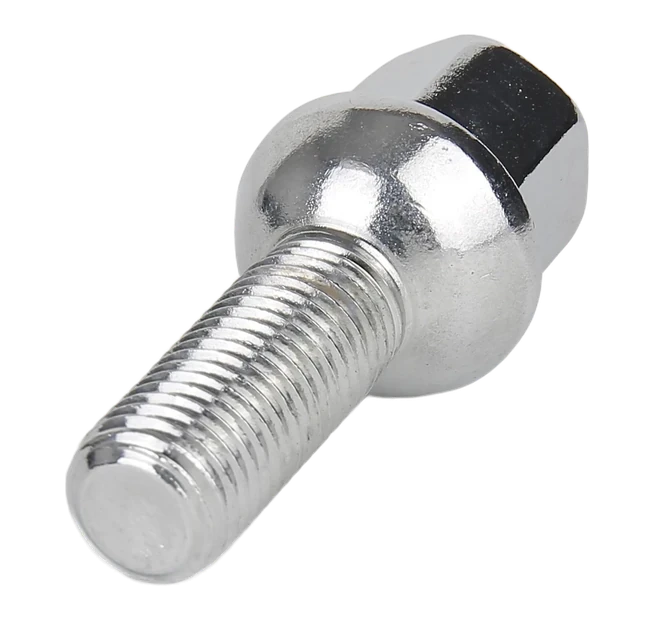
- For a bolt: thread length is measured from the seat to the tip. Too short and the bolt does not engage enough thread in the hub; too long and it can touch parts behind the hub. Thicker aftermarket wheels and slip-on spacers need longer bolts.
Then the hex. The wrench size across flats: usually 17 mm on bolts (19 mm on some older and heavier models, 24 mm on large vans) and 17 to 22 mm on nuts. Tuner wheels with small lug holes use slim spline-drive nuts turned with a key.
03Same Car, Different Fastener
The vehicle decides nut or bolt, but the wheel decides the seat and often the length. That is why one car can need two or three different fasteners:
- Steel vs alloy wheels. Toyota Corolla steel wheels use a 60° cone nut; many Toyota alloy wheels use a mag seat nut with a flat washer, same thread and hex. Peugeot and Citroën steel wheels use a 60° cone bolt with 26 mm thread length; their alloy wheels use a flat-seat bolt with 17 mm thread length.
- Aftermarket wheels. Most aftermarket alloy wheels have a 60° cone seat, even on cars whose OE wheels use ball or flat seats. A VW owner fitting aftermarket wheels usually needs cone-seat bolts, not the original ball-seat bolts.
- Wheel spacers. A slip-on spacer moves the wheel outward, so bolts must be longer by the spacer thickness, and nuts need longer studs to keep full thread engagement.
For a distributor this matters more than any single fitment: a range built only on OE specifications will miss the alloy-wheel and aftermarket-wheel versions that many end customers actually need.
04When You Only Have a Sample
If a customer sends a used part instead of an OE number, measure four things:
- Thread: measure the outside diameter (about 12, 14 or 16 mm on cars) and check the pitch with a thread pitch gauge. Do not rely on a caliper alone for pitch.
- Seat: a cone seat is a straight taper; a ball seat is curved. Check the radius with a radius gauge or by fitting it into a known R12 / R13 / R14 seat.
- Length: for a bolt, measure from the seat to the tip; for a nut, measure overall height and note open or closed end.
- Hex: measure across flats.
Photos of the part next to a ruler, plus a photo of the wheel’s lug hole, are usually enough for a manufacturer to confirm the specification before sampling.
05Common Mistakes
| Mistake | What happens | How to avoid it |
|---|---|---|
| Cone-seat fastener on a ball-seat wheel, or the reverse | Clamps on a ring or a point and can work loose | Confirm the wheel’s seat, not only the car |
| Wrong ball radius (R12 vs R13 vs R14) | Partial contact, uneven clamping | State the radius on every ball-seat order |
| M12×1.25 and M12×1.5 mixed up | Threads start, then jam or strip | Check the pitch with a gauge or the OE number |
| Bolt too short after fitting thicker wheels or spacers | Too little thread engaged in the hub | Add the extra thickness to the OE thread length |
| Bolt too long | Touches parts behind the hub | Start from the OE length; do not just “go longer” |
| OE steel-wheel spec used for alloy wheels | Wrong seat or length for alloy wheels | List steel and alloy versions separately |
06RFQ Checklist for Importers
Put these in every request for quotation, per specification:
- Vehicle make, model and years, or the OE number
- Nut or bolt
- Thread size and pitch
- Seat type, and the ball radius if it is a ball seat
- Hex size
- Length: bolt thread length (seat to tip), or nut height and open or closed end
- Strength class (our car lug nuts: usually class 8 or as specified; lug bolts: class 10.9)
- Finish and corrosion target, stated as neutral salt-spray hours (see our lug nut plating guide)
- Marking, packaging and labels
- Quantity per specification, and whether different specifications can ship together
Tightening torque is set by the vehicle maker; your instructions to end users should refer to the vehicle’s specified torque, applied with a torque wrench.
07How We Match Fasteners
Most of our customers do not order by “type”. They send an OE number, a vehicle list or a sample, and we confirm thread, seat, length and hex before quoting. Our Lug Nuts and Lug Bolts pages list our standard fitments by make and model, with thread, seat, hex and, for bolts, thread length. MOQ is 5,000 pieces per specification, and different specifications can ship in one container, so a distributor can cover nut and bolt vehicles, steel and alloy versions, in one order.
08Questions Buyers Ask
Which cars use lug bolts instead of lug nuts?
Most European brands: Volkswagen, Audi, Skoda, Seat, Mercedes-Benz cars, BMW, Mini, Peugeot, Citroën, Renault, Dacia, Fiat, Alfa Romeo, Volvo and modern Porsche. There are exceptions, usually models built on an Asian platform, such as the Peugeot 4007 or Fiat Fullback, which use lug nuts.
Can I use a 60° cone seat lug nut or bolt on a ball seat wheel?
No. The seat of the fastener must match the seat of the wheel, including the ball radius (R12, R13 or R14). A mismatched seat clamps the wheel on a small area and can loosen.
What is the difference between M12×1.5 and M12×1.25?
Both are 12 mm in diameter; the pitch, the distance between threads, is 1.5 mm or 1.25 mm. M12×1.5 is used by Toyota, Hyundai, Kia, Mazda, Mitsubishi, Honda, Ford and many others; M12×1.25 by Nissan, Suzuki and many Peugeot, Citroën, Fiat and Alfa Romeo models. They are not interchangeable.
Do lug nuts for steel wheels fit alloy wheels on the same car?
Not always. Many cars use a different seat or length on alloy wheels, for example a mag seat nut with a washer instead of a cone nut, or a shorter flat-seat bolt instead of a cone-seat bolt.
How do I choose the bolt length for aftermarket wheels or spacers?
Start from the OE thread length for the vehicle and add the extra wheel or spacer thickness, so the bolt engages the same amount of thread in the hub. Check that the longer bolt does not touch parts behind the hub.
What strength class should lug nuts and bolts be?
Our passenger car lug nuts are usually class 8, or the class the customer specifies. Our lug bolts and wheel studs are class 10.9. Always state the class in your specification.